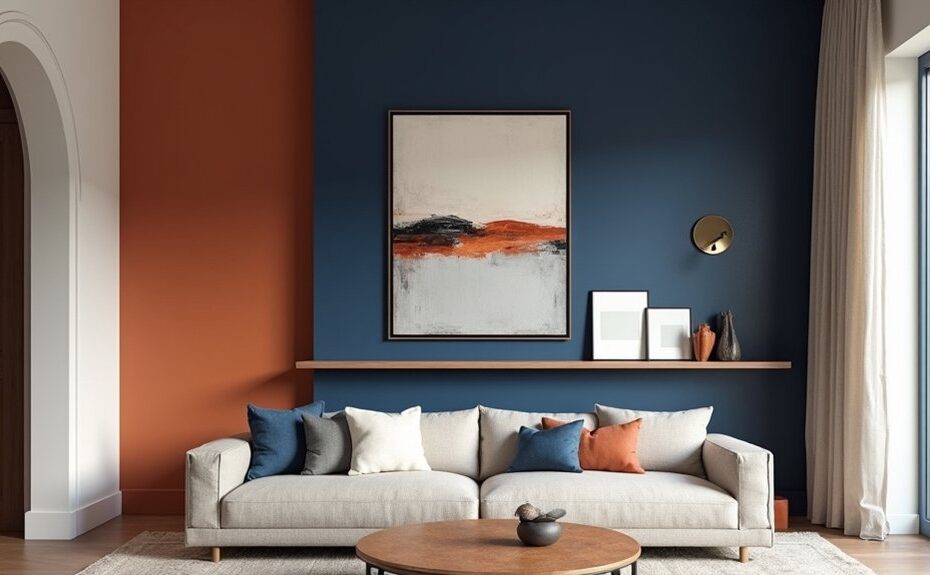
If your walls feel flat, you don’t need more clutter—you need smarter color and placement. You can pick a bold shade that matches your room’s light, scale, and mood, then concentrate it where it counts: one wall, the ceiling, or crisp color-block shapes made with painter’s tape. You can even paint a backdrop that makes art look curated, not random, and build a gallery wall with clean spacing and ideal height. Next, it comes down to…
Key Takeaways
- Choose bold paint by room light, size, and mood; warm hues suit north light, saturated jewel tones thrive in south light.
- Make impact by painting one focal wall or the ceiling; keep trim crisp and pick a finish that suits the surface.
- Use painter’s tape to create simple color-block geometry; limit to two or three hues and seal edges for sharp lines.
- Paint a backdrop shape behind art to frame it; pull a darker accent from the artwork and size the shape slightly larger.
- Build a bold-paint gallery wall with consistent spacing and proper height; center the display at 57–60 inches and align outer edges.
Choose Bold Paint by Light, Size, and Mood

Wondering why that “perfect” bold color looked electric in the store but flat on your wall? Your light is the real filter. North-facing rooms cool colors down, so warm reds, ochres, and clay tones keep them lively. South light amplifies saturation, so you can handle deeper emeralds, inky blues, and spicy magentas without gloom.
Scale matters, too. In small spaces, choose mid-tones or slightly grayed brights to avoid visual squeeze; in larger rooms, go richer to prevent the color from drifting bland. Use color psychology to set the vibe: cobalt boosts focus, green steadies, terracotta feels social.
Finally, match paint finish to function—matte hides flaws, eggshell balances glow, satin pops where you want energy.
Use Bold Paint on One Surface (Wall or Ceiling)
If you’re not ready to go full-drench, put your bold color on one surface and let it do the heavy lifting. Pick the wall your eye lands on first—behind the bed, sofa, or entry console—and paint it like a backdrop for the room’s best pieces. You’ll get instant color contrast without shrinking the space, especially if the other walls stay warm white or a soft neutral.
Or go overhead: a painted ceiling feels designer, frames your lighting, and can visually lower a tall room for a cozier vibe. Match the finish to surface texture—matte hides rough drywall, while satin makes smooth plaster or beadboard glow. Keep trim crisp to sharpen edges and make the single statement read intentional.
Add Color-Block Shapes With Painter’s Tape
While a full mural can feel like a commitment, painter’s tape lets you drop in crisp color-block shapes—arches, half-walls, checker bands, even an off-center “headboard” rectangle—without touching the whole room. You’ll get instant architecture and a designer edge with clean lines and intentional negative space.
Start by testing layout with tape: keep shapes at door-handle height in tight rooms, and scale up in open plans so the blocks don’t look fussy. Pick two to three hues max, then push Color contrast—inky navy with clay, butter yellow with crisp white—to make the geometry pop.
Try Geometric patterns like stacked steps or a grid band to visually widen a narrow wall. Seal tape edges, roll paint away from the tape, then peel for razor-sharp results.
Paint a Wall Backdrop That Frames Your Art
Because your art deserves more than a blank expanse, paint a “backdrop” shape behind it—an oversized rectangle, halo arch, or soft-edged block that turns the wall into a curated gallery moment.
Pick a hue that amplifies the artwork’s undertones: inky blue for warm brass frames, clay for sun-faded prints, or deep olive for black-and-white photography.
Keep color harmony by pulling one accent from the piece, then shifting it one shade darker on the wall.
Use finish to add texture contrast: matte behind glossy frames, eggshell behind canvas, or limewash for a lived-in, design-forward vibe.
Scale the shape slightly larger than the frame so it reads intentional, not cramped.
Tape crisp edges, or feather paint for a modern mural look.
Build a Bold-Paint Gallery Wall (Spacing and Height)
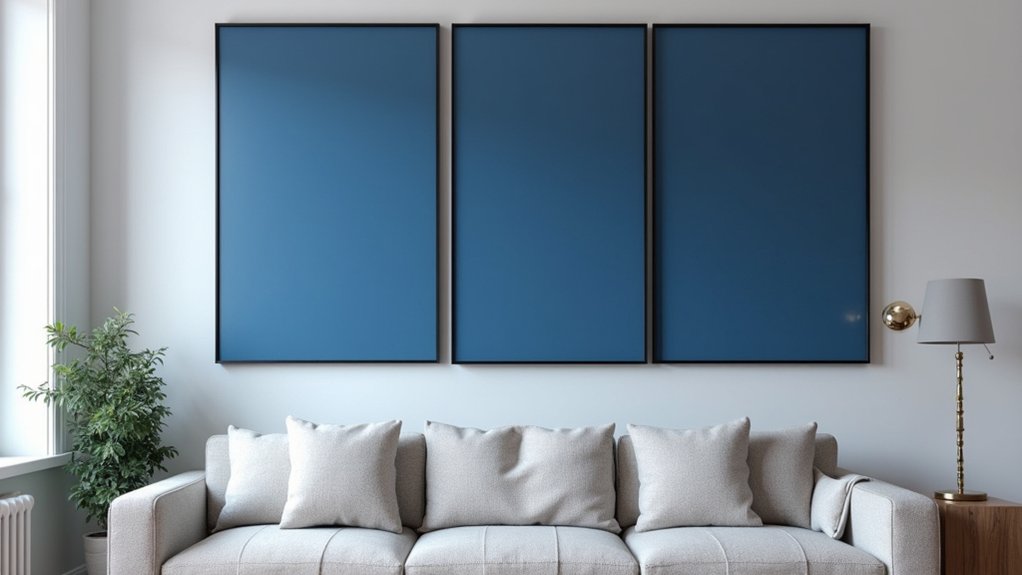
Once you commit to bold paint, treat your gallery wall like a designed grid—not a scattered collage—by nailing the spacing and hang height first. Start with consistent wall spacing: aim for 2–3 inches between frames for a clean, gallery-grade look, or 1.5 inches if you want a tighter, editorial vibe. Use painter’s tape to map edges so the color field reads intentional, not busy.
Set artwork height by anchoring the visual center at about 57–60 inches from the floor, then adjust for sofas or consoles so the bottom row sits 6–8 inches above furniture. Mix sizes, but keep outer edges aligned to your painted shape.
On saturated walls, matte frames and wide white mats keep contrast crisp and modern.
Frequently Asked Questions
How Do I Prep Textured Walls Before Applying Bold Paint?
Grab your DeLorean: you’ll prep textured walls by washing, patching, then sanding for Texture smoothing, vacuuming dust, and caulking edges. You’ll nail primer application with a stain-blocking, high-build primer, then paint boldly in balanced layers.
Which Paint Finish Hides Imperfections Best in High-Traffic Rooms?
Choose an eggshell or satin finish; it hides minor flaws better than gloss and stands up to traffic. Use smart furniture placement to avoid scuffs, and lean on color coordination to keep the space polished.
How Many Coats Does Saturated Paint Typically Require for Full Coverage?
You’ll typically need 2–3 coats of saturated paint for full coverage, especially on big, bright walls. You’ll cut coats by smart Color mixing and priming, and you’ll boost paint durability with quality formulas and cure time.
What’s the Safest Way to Ventilate a Room While Painting Indoors?
You’ll ventilate safest by opening opposite windows for Air circulation, running Ventilation fans exhausting outward, and keeping doors ajar. You’ll wear a respirator, take breaks, and avoid lingering fumes, especially in small, color-drenched rooms.
How Do I Remove Bold Paint Later Without Damaging the Drywall?
Prime first, then later score edges, steam gently, and peel with a wide knife so you don’t gouge drywall. You’ll sand lightly, patch, and reprime. Smart Color mixing and paint durability choices make removal cleaner.