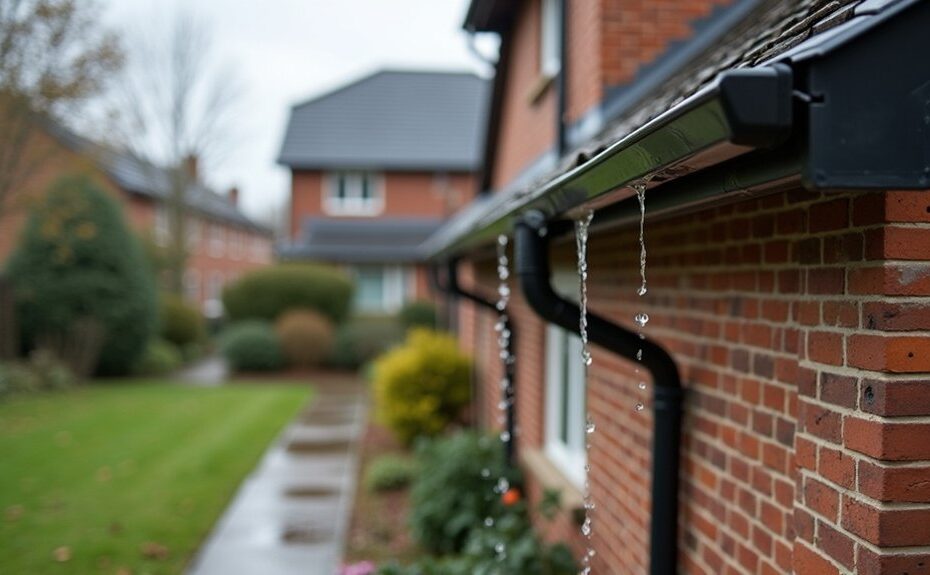
Your guttering is the building’s bloodstream, and one blockage can cause a silent backflow. You’re responsible for keeping water discharge compliant and controlled, because overflow drives damp ingress, mould risk, and fabric deterioration at fascia, brickwork, and foundations. You should verify flow paths, bracket integrity, correct fall, and joint seals before minor defects become structural exposure. If you miss the early indicators, the next heavy rainfall will show you exactly where the weak points are…
Key Takeaways
- Inspect gutters after heavy rain or storms for overflow, ponding, staining, damp patches, or sagging runs that signal drainage failure.
- Clean gutters and outlets regularly; remove debris and sediment, then flush channels and downpipes to restore full, fast flow.
- Repair leaks promptly by drying surfaces, removing failed sealant, and applying UV-stable gutter sealant or compatible patching to joints and cracks.
- Correct sagging by fixing sound fascia, resetting bracket spacing, and rehanging to a consistent fall so water doesn’t backfall and spill.
- Ensure downpipes discharge away from walls and foundations, and address ventilation and wet insulation to prevent damp, timber decay, and mould.
Signs Your Guttering Is Blocked, Leaking, or Loose

If your guttering isn’t moving roof runoff cleanly to the downpipes, it’s already operating out of spec and increasing the risk of water ingress and structural damage. You’ll see overflow at eaves during rainfall, staining on fascia/soffit, and splashback marking brickwork. Persistent damp at internal corners or below rooflines indicates uncontrolled discharge.
You can identify Gutter debris by ponding in the channel, vegetation growth, and slow drawdown after showers. Look for joint weeping, drip lines, or sealant failure at unions and outlets—these indicate leakage under hydraulic head.
Check fixings: brackets pulled from rafters, sagging runs, or misaligned fall mean the system won’t meet required gradients. If downpipes gurgle or backflow, you need Blockage removal before load-induced deformation worsens.
Clean Guttering and Downpipes Safely (Tools and Steps)
Blocked or leaking guttering needs cleaning before you attempt resealing, regrading, or replacing fixings, because debris-driven ponding and backpressure distort flow and hide failure points.
Start by isolating access: set a stable ladder at 4:1, tie it off, and keep three points of contact. Use safety equipment: gloves, eye protection, non-slip footwear, and, where required, a harness and anchor.
Apply cleaning techniques in a controlled sequence. Scoop debris with a gutter trowel into a bucket, not onto roofs or paths. Flush runs with a hose from the downpipe end toward the outlet to confirm gradient and free discharge.
Clear downpipes using a drain rod or plumber’s snake, then re-flush to verify full-bore flow. Finish by checking brackets for movement and ensuring overflows discharge safely.
Fix Leaking Guttering Joints, Seals, and Small Cracks
After you’ve cleaned the run, inspect every gutter joint and seal for active drips, staining, or separation, since leaks can drive fascia rot and moisture ingress.
You’ll reseal leaking joints by drying the surfaces, removing failed sealant, and applying a gutter-rated, UV-stable sealant to the specified bead and cure time.
You should patch small cracks immediately with a compatible repair patch or sealant system so you don’t lose hydraulic capacity during peak rainfall.
Seal Leaking Gutter Joints
Although your gutters may look intact from the ground, leaking joints and failed seals can let water bypass the channel and wet fascias, soffits, and wall assemblies, accelerating decay and corrosion.
For compliant Leak repair, inspect joints during rain or by hose testing, then mark leaks. Follow the manufacturer’s method for your system type (uPVC, aluminium, steel) and replace degraded gaskets or union brackets where specified.
Clean and dry mating surfaces, remove loose sealant, and lightly abrade if required for adhesion. Apply compatible Gutter sealants in a continuous bead, tool it to eliminate voids, and reassemble to the correct overlap and fastener torque.
Maintain fall and alignment so joints aren’t stressed. Allow full cure time before re-testing and documenting results.
Patch Small Cracks Fast
Small hairline cracks in gutter runs or downpipe spigots can shed water behind the fascia and into wall assemblies, so you should treat them as defects requiring prompt, compliant repair rather than “minor” wear.
Start with Crack inspection after rain and during dry conditions: look for staining, pinholes, split seams, and UV-brittle sections, then confirm leaks with a controlled hose test.
Clean and dry the area, remove loose coatings, and abrade lightly so the bond meets manufacturer requirements.
Use compatible patch tape or a rated polyurethane sealant; avoid generic silicones that can debond.
Apply primer if specified, then complete Seal application in a continuous bead and tool it to eliminate voids.
Recheck fall, brackets, and overflow paths to prevent repeat cracking.
Stop Gutters Sagging: Brackets, Fall, and Fascia Checks
When your gutters start to sag, they stop draining as designed and can overload fasteners, distort the fascia line, and dump water where the building envelope can’t tolerate it. Act early and restore line and level before joints fatigue and fixings fail.
Begin with a fascia inspection: confirm the board is sound, straight, and securely fixed to rafter tails, with no rot, splitting, or pull-out.
Next, perform bracket adjustment—reset spacing to manufacturer limits, re-seat brackets on solid substrate, and replace corroded screws with correct-grade fixings.
Verify the fall with a level or laser; rehang to achieve a consistent gradient to each outlet, avoiding backfall and ponding.
Check for spread at unions and end caps after re-tensioning, and torque fixings to spec.
Prevent Damp and Mould Caused by Overflowing Guttering
How does overflowing guttering turn into damp and mould so quickly? When runoff spills past the fascia, it saturates masonry, cladding joints, and cavity barriers, defeating weatherproof detailing. Capillary action then drives moisture into wall linings and timber, and you’ll see staining, musty odours, and elevated RH within days.
Treat it as a compliance risk: persistent wetting can breach moisture performance expectations in UK building practice and accelerate timber decay.
Stop the pathway. Ensure downpipes discharge freely and that outlets align, so water doesn’t backtrack into soffits. Check that roof insulation hasn’t become wet or compressed, because that lowers thermal resistance and increases interstitial condensation risk.
Pair remedial works with ventilation enhancement in lofts and bathrooms to keep humidity below mould thresholds. Repaint or re-seal affected interfaces only after substrates dry fully.
Guttering Maintenance Schedule (Monthly, Seasonal, Annual)
You should follow a defined guttering maintenance schedule to control overflow risk and protect the building envelope. Each month, you’ll perform a visual check for debris, sagging, joint separation, and downpipe discharge to confirm drainage remains compliant with design intent.
You’ll then complete seasonal and annual cleaning—timed around leaf-fall and prior to heavy rainfall—to remove blockages and verify brackets, seals, and outlets remain serviceable.
Monthly Visual Checks
Why wait for an overflow to flag a gutter problem? Each month, you should complete a ground-level visual inspection aligned with your gutter design capacity and rainwater harvesting requirements.
Check for sagging lines, pulled brackets, split joints, and displaced stop-ends that can breach watertightness and trigger damp ingress.
Verify downpipes sit plumb, connections are seated, and outlets aren’t distorted, as misalignment increases hydraulic losses and surcharge risk.
During rainfall, observe flow: water should track to outlets without sheeting over fascias or backflowing at corners.
Look for staining on soffits, masonry, or foundations; it indicates repeated overtopping.
Confirm guards, leaf screens, and diverter components remain intact and correctly positioned.
Record defects and schedule prompt repairs before the next storm event.
Seasonal And Annual Cleaning
Monthly visual checks catch early movement and leakage, but seasonal and annual cleaning controls the root causes of blockage and capacity loss. Each autumn and spring, clear leaves, silt, and moss from gutters, outlets, and downpipes, then flush to verify free discharge and full cross-sectional capacity.
You should inspect joints, brackets, and seals while access equipment is in place, and replace failed fixings to maintain design fall and prevent ponding.
Match methods to Gutter material: use non-abrasive tools on uPVC and coated steel, and avoid aggressive chemicals on aluminium and cast iron.
Account for Weather impact: after storms, snow melt, or prolonged drought, check for debris surges, thermal movement, and fine sediment.
Annually, document condition, corrosion, and remedial actions.
Frequently Asked Questions
Do I Need Planning Permission to Replace or Reroute Guttering?
You usually don’t need planning permission to replace guttering; rerouting may if it alters appearance, affects drainage, or involves Property extensions. Example: you extend a rear roofline; Building regulations may require compliant downpipe discharge and access.
What Guttering Material Lasts Longest in Coastal or Industrial Areas?
You’ll get the longest service life with marine-grade aluminium or 316 stainless steel guttering; both maximise corrosion resistance and material durability. Specify compliant coatings/fixings, isolate dissimilar metals, and schedule inspections to mitigate pitting, galvanic attack.
Will Gutter Guards Work With Heavy Leaf Fall and Moss?
Yes, they’ll work, even if you think they’ll clog. You must choose tested micro-mesh and maintain it quarterly for leaf prevention and moss control, meeting flow-rate capacity and fire-debris standards to reduce overflow risk.
How Much Does Professional Gutter Cleaning Typically Cost?
You’ll typically pay $120–$300 for professional gutter cleaning; multi-storey or severe debris can run $350–$600. Use cost comparison quotes and seasonal pricing. Guarantee OSHA-safe access, liability insurance, and documented debris disposal to reduce hazards.
Does Home Insurance Cover Damage From Blocked or Failed Guttering?
Home insurance usually won’t cover gutter damage from blocked or failed guttering because you must maintain it; Insurance coverage may apply only to sudden, insured perils causing resultant damage. You’ll need evidence and comply with policy exclusions.