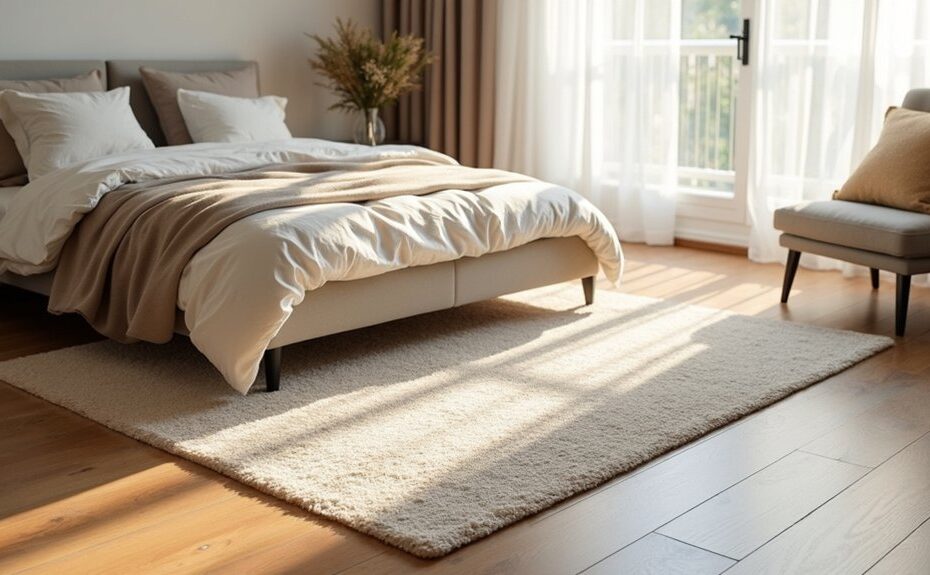
You might not know that your bedroom’s flooring can change perceived room temperature and nighttime noise levels by measurable amounts. You’ll want to balance warmth underfoot, sound control, and maintenance before you pick a surface. Carpet can maximize insulation, cork can dampen impact, and wood or vinyl can keep a clean, tailored look with different wear profiles. The best choice depends on one factor most people overlook…
Key Takeaways
- Carpet feels warmest and quietest, offering great insulation and noise absorption; choose dense face weight with a quality pad for durability.
- Cork is cushioned, warm underfoot, and naturally sound-dampening; use 10–12 mm planks with insulated underlayment, especially over concrete.
- Hardwood delivers timeless style and resale value; pick matte or wire-brushed, low-VOC finishes to hide scratches and improve air quality.
- Engineered wood adds hardwood style with better stability; acclimate 48–72 hours and keep indoor humidity around 35–55% to prevent movement.
- Luxury vinyl plank provides waterproof comfort and easy care; choose rigid SPC cores and a 20-mil wear layer for long-lasting bedroom performance.
Choose Bedroom Flooring: Warmth, Noise, Upkeep
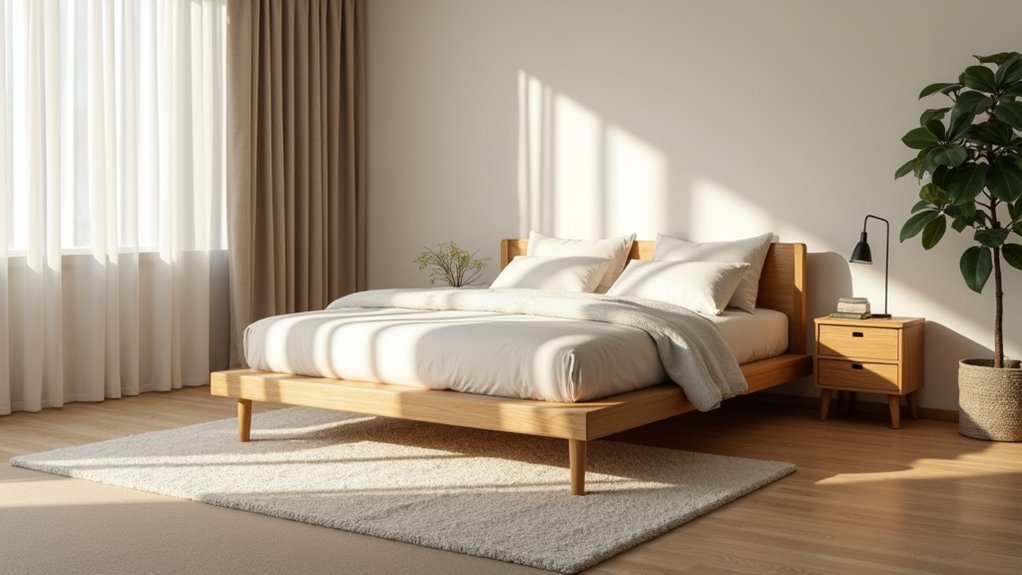
How do you pick bedroom flooring that actually feels comfortable day to day? Start by balancing surface temperature, sound transmission, and maintenance.
If you want warmth underfoot, choose materials with low thermal conductivity (engineered wood, cork) or pair any hard surface with an insulated underlayment and area rugs.
To reduce noise, prioritize thicker planks, resilient cores, and acoustic underlay rated by IIC/STC; you’ll cut footfall and room-to-room transfer.
For upkeep, compare wear layers, scratch resistance, and moisture tolerance; sealed finishes clean fast, while textured surfaces trap dust.
Match performance to personal style by selecting plank width, sheen, and texture, then lock in color coordination with wall paint, trim, and lighting temperature for the space.
Carpet for Bedrooms: Warmest and Quietest
Carpet checks the two comfort boxes that matter most in a bedroom—warmth underfoot and noise control—once you’ve weighed temperature, sound transmission, and upkeep. Its pile traps air, boosting insulation and raising perceived floor temperature, especially over slab.
It also absorbs impact and high-frequency noise, reducing footfall, dropped-item clatter, and room-to-room echo.
To keep performance consistent, choose a dense face weight and a quality pad; both improve compression recovery and acoustic damping.
For minimal maintenance, pick solution-dyed nylon or polyester with stain resistance and vacuum weekly with a HEPA unit.
If you need allergy relief, use low-pile carpet, a sealed subfloor, and frequent filtration-focused cleaning to limit dust reservoirs and dander.
Cork Bedroom Flooring: Soft and Sound-Dampening
If you want a resilient bedroom floor that still feels soft, cork gives you built-in cushioning that reduces foot fatigue.
You’ll notice less impact noise because cork’s cellular structure absorbs vibration and dampens footsteps.
You can improve nighttime comfort and privacy without adding thick underlayment.
Cushioning Underfoot Comfort
Because bedrooms reward quiet and comfort more than hard-wearing traffic performance, cork flooring stands out for its naturally cushioned feel and built-in sound control. Its cellular structure compresses under load, then rebounds, so you get less heel fatigue when you’re barefoot and a gentler landing when you step out of bed.
Choose 10–12 mm planks for noticeable compliance without a “spongy” feel, and verify the wear layer thickness for long-term dent resistance.
For installations over concrete, add Underlay insulation to reduce cold transfer and stabilize feel. If you float the floor, pair it with high-density Foam padding that’s rated for cork, so seams stay tight and the surface doesn’t telegraph subfloor imperfections.
Natural Acoustic Noise Reduction
How do you keep a bedroom quiet without adding thick soft surfaces? Choose cork bedroom flooring: its closed-cell structure traps air, so it absorbs footfall and reduces reflected sound. You’ll notice less clicking from hard shoes and fewer vibrations transferring through the subfloor.
For better isolation, pair cork with practical soundproofing techniques: install a high-density cork underlayment, seal perimeter gaps with acoustic caulk, and decouple baseboards from the floor with a thin foam strip.
If you’re fighting TV or street noise, combine flooring with targeted acoustic panel options on the wall behind the bed or on the ceiling above the primary reflection point. You get a quieter room without sacrificing warmth, cleanability, or a modern, resilient surface.
Hardwood for Bedrooms: Timeless, Higher Resale Value
While softer surfaces can feel cozy underfoot, hardwood brings a timeless, architectural look to a bedroom and signals quality to future buyers. You’ll typically see stronger resale comps when your flooring matches common preferences like 2 1/4–5 inch planks in oak, maple, or hickory with a low-gloss topcoat.
Choose factory-finished boards with aluminum-oxide urethane for better scratch resistance and simpler maintenance.
For indoor air quality, specify low-VOC finishes and confirm CARB Phase 2 compliance for any cores or coatings.
Elegant finishes like matte or wire-brushed textures hide micro-scratches and reduce glare from bedside lighting.
Ask for Sustainable sourcing (FSC or PEFC) and verify moisture content at delivery to prevent gaps after installation.
Engineered Wood for Bedrooms: Resists Seasonal Movement
If you want wood floors in a bedroom without seasonal gaps or cupping, you’ll get better dimensional stability from engineered planks because their cross-layered core resists expansion and contraction.
You can install them as floating, glue-down, or nail-down systems, but you’ll still need proper acclimation, flat subfloors, and correct underlayment to control moisture and noise.
You’ll keep them performing by maintaining indoor humidity, using felt pads, and cleaning with a damp—not wet—method to protect the wear layer and seams.
Dimensional Stability Benefits
Because bedrooms often experience subtle shifts in temperature and humidity across seasons, engineered wood flooring offers a practical stability advantage. You get higher dimensional stability because its cross‑layered core distributes internal stresses instead of concentrating them along one grain direction. That structure reduces cupping, crowning, and edge gapping when indoor RH swings between heating and cooling periods.
Compared with solid planks, you’ll see less flooring expansion and contraction across the width, so boards stay flatter and seams stay tighter under typical household conditions. You also lower the risk of squeaks caused by intermittent movement and fastener stress.
If your bedroom sits over an unconditioned space or near exterior walls, engineered wood better tolerates localized moisture gradients without visible distortion. This keeps your surface consistent under rugs and furniture loads year‑round.
Installation And Maintenance Tips
Even though engineered wood handles seasonal RH swings better than solid planks, you still need a controlled install to lock in that stability. Acclimate cartons 48–72 hours in the bedroom with HVAC running, targeting 35–55% RH.
Check subfloor flatness to 3/16 inch over 10 feet, and confirm moisture: wood subfloors below 12% MC and within 4% of the flooring; concrete passes RH or CaCl tests.
Use a vapor retarder where required, and leave 3/8-inch expansion gaps at walls and thresholds.
For maintenance, set Cleaning protocols: dry dust-mop weekly, damp-clean with a pH-neutral wood cleaner, and avoid steam.
Use felt pads and rugs to protect finish and preserve material durability.
Repair scratches early using matching filler.
Luxury Vinyl Plank for Bedrooms: Waterproof and Cushioned
Although bedrooms don’t face the same spills as kitchens, luxury vinyl plank (LVP) still fits well because it combines a waterproof wear layer with a slightly cushioned core that feels warmer and quieter underfoot than many hard surfaces.
As Waterproof flooring, LVP resists humidity from ensuite baths and wet shoes, reducing swelling and staining risk. Choose 20-mil wear layers for durability, and look for rigid SPC cores if you want higher dent resistance under beds and dressers.
For Cushioned comfort, add an attached pad or pair it with an underlayment rated for LVP to improve impact sound and footfall feel.
Verify the locking profile, keep expansion gaps, and select embossed textures for better slip control.
Laminate for Bedrooms: Budget Look, Scratch-Resistant
Laminate gives you a wood-look bedroom floor at a lower price point than LVP while still holding up well to daily abrasion from shoes, pets, and rolling laundry baskets. For affordable aesthetics, pick a high-definition printed décor layer with a matte, embossed-in-register texture to reduce shine and repeat patterns.
Prioritize scratch resistance by choosing AC3 or AC4 wear ratings and thicker planks (10–12 mm) for better impact performance and sound. Install a quality underlayment with an integrated vapor barrier over concrete, and leave proper expansion gaps to prevent edge peaking.
Keep moisture controlled: wipe spills fast, avoid steam mops, and use felt pads under bed frames and nightstands. If your bedroom connects to a bath, add a sealed junction and consider water-resistant laminate cores.
Frequently Asked Questions
What Flooring Is Best for Allergy Sufferers in Bedrooms?
You’ll do best with sealed hard surfaces—tile, vinyl, or hardwood—like a clean-room standard; they trap fewer allergens. Choose Allergy friendly materials and Hypoallergenic flooring, keep seams sealed, and damp-mop regularly to reduce dust mites.
Can I Install Radiant Floor Heating Under Bedroom Flooring?
Yes, you can install radiant floor heating under most bedroom flooring if you match system type to material. Use radiant heating with proper floor insulation, vapor control, and manufacturer-approved underlayment to prevent overheating, warping, and noise.
How Much Does Bedroom Flooring Installation Typically Cost per Square Foot?
You’ll typically pay $2–$12 per sq ft for bedroom flooring installation, depending on labor and subfloor prep. Do a flooring material comparison, and budget for flooring maintenance, underlayment, shifts, and disposal fees.
Which Bedroom Flooring Options Are Best for Pets and Claw Resistance?
You’ll get the best pet results from luxury vinyl plank/tile and tile: they’re Pet proof flooring with top Claw resistant options. Choose 20+ mil wear layers, rigid cores, sealed seams, and textured finishes. Avoid softwoods.
How Long Do Different Bedroom Flooring Types Usually Last?
You can expect carpet 5–15 years, laminate 10–25, vinyl 10–20, engineered wood 20–40, hardwood 50+ (refinishable), tile 50+. Use Durability comparison and Cost analysis to match lifespan against upkeep, budget.